Running skills in claude -p or CI: which ones stop to ask
Some skills are built to ask questions before they act. In a one-shot headless run that means you get a question back, not a document. Notes from 47 runs on what to expect.
By Jimmy Lv · 2026-11-25 · Every number here comes from a real run, linked to its field note.
All 47 of our test runs were headless: claude -p with one prompt and no chance to reply. That is how skills run in CI, cron jobs and scripts. It is also where a skill designed for conversation behaves differently from what its README promises.
Skills that return a question, by design
- brainstorming: asked one question back after 16 seconds ("what should the email do for the reader?"). The skill tells Claude to ask one question at a time before proposing anything.
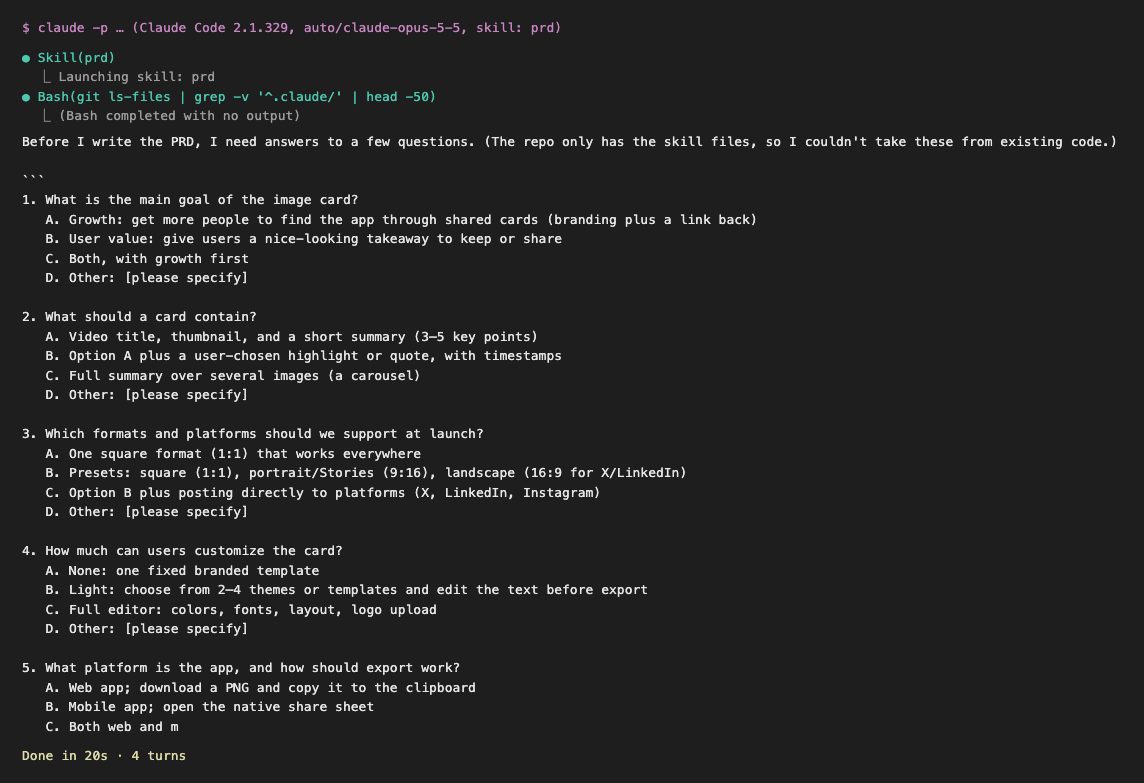
- prd: asked a round of lettered clarifying questions after 22 seconds. No PRD was written. Answer them and run again.
Both were among the four fastest runs in the batch. A short run time on a big request is a sign you got questions, not work.
Skills that are supposed to wait, but did not
file-organizer was told to show the plan before moving anything. It moved the 12 files first, then opened its reply by admitting it. Nothing was deleted, it used mv -n and wrote a move log, so it was reversible. Do not rely on its plan-first step in an unattended job.
Skills that quietly skip a mode
- design-motion-principles has an audit mode that asks you to pick a design direction and writes an HTML report. Our prompt said fix in place, so Claude skipped both and said so. Ask for the report explicitly if you want it.
- docs-writer wrote the quickstart but asked before rewriting install.md. In a headless run the rewrite simply does not happen.
- commit-work left .env and a scratch demo.js uncommitted on purpose. Good for safety, surprising if a script expects a clean tree afterwards.
Skills that are safe to run unattended
These finished the job and verified it inside the same run, with the check reproduced by us afterwards where marked re-checked on the skill page:
| Skill | Self-check in the run | Seconds |
|---|---|---|
| fastapi-templates | uv run pytest: 12 passed | 118 |
| nuxt | nuxi build, then fetched /api/hello from the built server | 63 |
| golang-pro | go vet and go test -race in docker | 84 |
| database-design | Tried two bad inserts, both rejected | 99 |
| docker-expert | Rebuilt to prove cache layers; 1.7 GB to 217 MB | 169 |
| typescript | --extendedDiagnostics before and after | 41 |
| Read the text back out of the new PDF | 51 |
Practical settings
- Put a time limit on the job. One run (marp-slide) waited on a hung child process until our 20 minute cap. Without the cap it would have run until the CI job timed out.
- Fail the job on a run that is suspiciously short for the task, or grep the result for a question mark at the end.
- If the skill must load, call it as /skill-name in the prompt. 8 of 47 did not load from a plain prompt. See which skills load on their own.
- Keep project settings only (we used that) so a personal skill or hook on the CI machine does not change the result.