47 headless runs: which Agent Skills Claude loads on its own
We gave 47 popular skills one real task each in a clean Claude Code session. 39 loaded from a plain prompt, 8 only when called by name. Here is the list and what the description had to do with it.
By Jimmy Lv · 2026-11-25 · Every number here comes from a real run, linked to its field note.
A skill only helps if the agent opens it. Directories, including this one, list skills by stars and installs, which says nothing about whether Claude will actually pick the skill up when you describe your task in plain words. So on 2026-11-22 we checked.
How the runs worked
- 47 skills, chosen by Search Console clicks to this site over 90 days. Skills that needed an account, a paid API or an image-generation key were skipped rather than faked.
- Each skill was copied into the .claude/skills/ folder of an empty project, with no other skills installed.
- Claude Code 2.1.329 ran headless (claude -p) on claude-opus-5-5 with project settings only, so nothing from a personal setup leaked in.
- The prompt described the task, never the skill. If the stream-json log showed no Skill call, the same task was re-run as /<skill-name>.
- Each run had a 20 minute limit. The full method is on the authors page.
The 8 that did not load from a plain prompt
| Skill | Task we gave it | What happened as /skill |
|---|---|---|
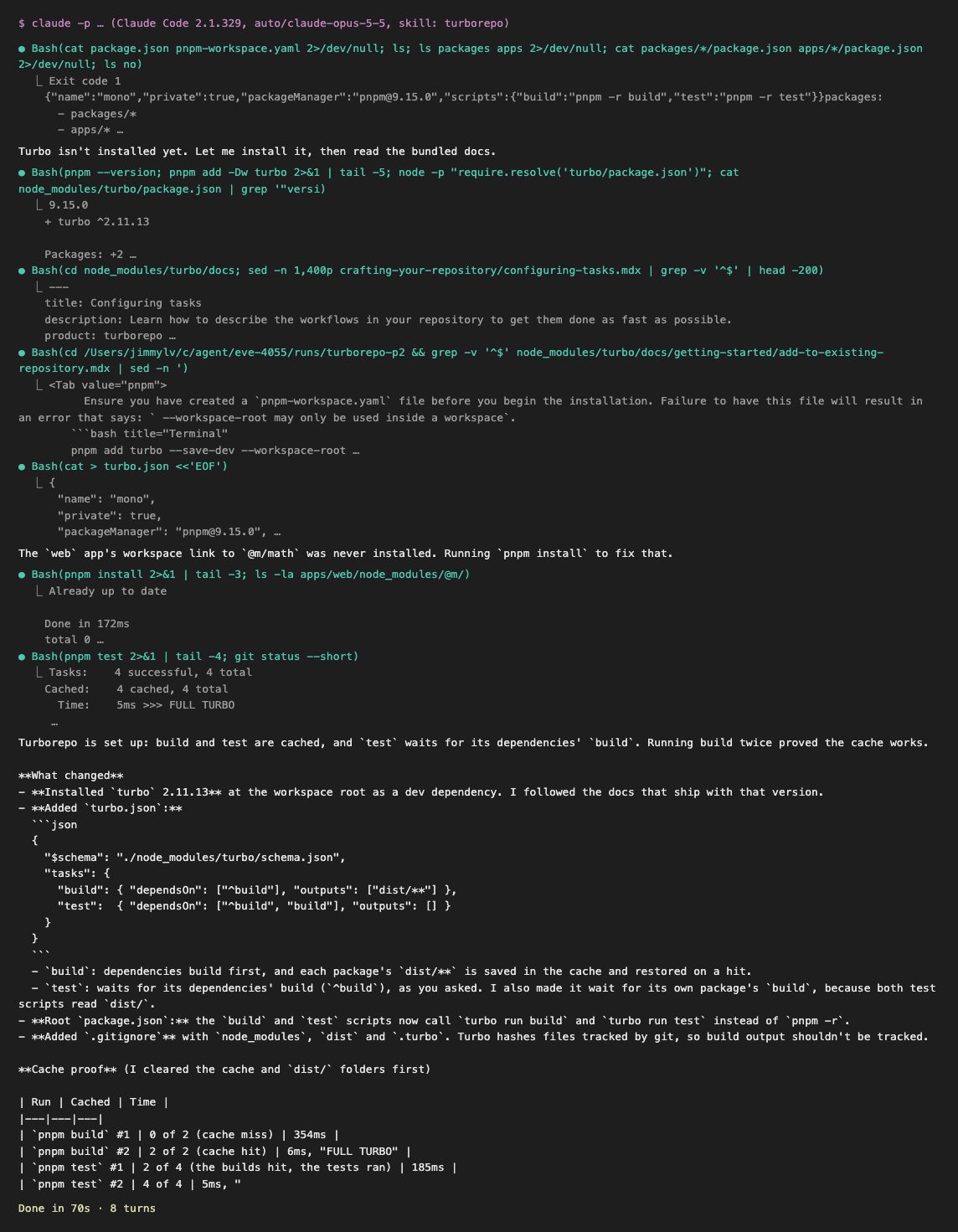
| turborepo | Set up turbo in a pnpm monorepo and prove the cache | Second build 2 of 2 cached, FULL TURBO |
| nestjs-expert | Protect /admin/stats with an API key guard, e2e tests | 4 of 4 e2e tests passed |
| mui | MUI v7 pricing grid with a dark/light toggle | Build passed; skill's own Grid example was v5 syntax |
| uv-package-manager | Move requirements.txt to uv with a lockfile | uv run pytest: 1 passed |
| heap-dump-analyzer | Find a Node memory leak with heap snapshots | +2,000 Buffers, +102.4 MB found and fixed |
| interaction-design | Loading, success and error states for a Save button | All three states, aria-live, reduced motion |
| data-storytelling | One-page data story from a funnel CSV | Chart style still came from the built-in dataviz skill |
| using-superpowers | Add a --version flag | No visible effect with no other skills installed |
The turborepo prompt literally said "set up turbo", and the NestJS task was a textbook guard. Neither loaded. So this is not a case of a vague prompt.
Was it the description?
The common advice is that a skill loads when its description says when to use it. We pulled the description of all 47 from the catalog. All 8 skills that did not load have a "Use when…" or "Triggers on…" clause. Among the 39 that did load, 28 do (72%). The median description length is about the same: 239 characters for the 8, 252 for the 39. heap-dump-analyzer repeats its own name three times as trigger phrases and still did not load.
So with one run per skill, we cannot point to a rule in the wording. What we can say is narrower: three of the eight are from the same collection (wshobson/agents, 3 of the 9 we ran from it), and a "use when" line is not a guarantee.
What to do with this
- If a skill matters for a task, call it by name. All 8 worked when called as /skill; the skill was never the problem, the selection was.
- Check the log, not the result. Several outputs looked fine either way, because Claude can often do the task without the skill. Only the Skill tool call in the log tells you the skill was read.
- Treat one run as one data point. We ran each skill once. A skill that loaded here can miss in your session with forty other skills competing for the same prompt.
Every skill in the batch
Each skill page has the full note: input, output, what went wrong, and when to skip it.
- agentation
Loaded on its own, 82s. Adding the toolbar to a Next.js app in dev only.
- ansible-role-creator
Loaded on its own, 56s. A first draft of a role you will test in a VM.
- better-icons
Loaded on its own, 61s. Finding icon ids across Iconify sets quickly from the terminal.
- brainstorming
Loaded on its own, 16s. An open-ended feature idea when you can go back and forth.
- commit-work
Loaded on its own, 21s. Splitting a messy working tree into clean conventional commits.
- copy-editing
Loaded on its own, 31s. Stripping filler from landing copy while keeping claims honest.
- database-design
Loaded on its own, 99s. Designing a schema where integrity rules belong in the database.
- design-motion-principles
Loaded on its own, 47s. Fixing animation that feels slow, floaty or decorative, especially dialogs and buttons.
- docker-expert
Loaded on its own, 169s. Slimming and hardening a Node image you already have.
- docs-writer
Loaded on its own, 66s. Docs where accuracy matters more than polish.
- excalidraw
Loaded on its own, 53s. Diagrams you want to keep editing by hand in Excalidraw afterwards.
- fastapi-templates
Loaded on its own, 118s. A new small FastAPI service where you want the layered structure from the start.
- file-organizer
Loaded on its own, 33s. Tidying a folder you have a copy of.
- frontend-design
Loaded on its own, 237s. Landing pages where looking different from every other AI page is the point.
- frontend-testing
Loaded on its own, 54s. Dify's frontend, where the docs it references exist.
- golang-pro
Loaded on its own, 84s. Concurrency patterns in Go where you want tests and race checks too.
- logging-best-practices
Loaded on its own, 30s. Replacing ad-hoc console.log with one structured event per request.
- marp-slide
Loaded on its own, 997s. Quick dark technical decks from Markdown.
- mobile-ios-design
Loaded on its own, 38s. A standard iOS settings or form screen that should follow the platform conventions.
- nextjs
Loaded on its own, 56s. Reviewing a client-heavy App Router page that should be a server component.
- nuxt
Loaded on its own, 63s. Scaffolding a Nuxt 4 app with the current directory layout.
- pdf
Loaded on its own, 51s. Pulling tables out of generated PDFs and producing simple report PDFs.
- prd
Loaded on its own, 22s. Starting a feature spec when you can answer a short round of questions.
- r3f-best-practices
Loaded on its own, 28s. React Three Fiber scenes that re-render or allocate every frame.
- react-dev
Loaded on its own, 59s. Generic, type-safe React components.
- react-native-design
Loaded on its own, 144s. Gesture and animation components where the snapping logic matters more than the styling.
- responsive-design
Loaded on its own, 24s. Retro-fitting an old fixed-width page to phones, or deciding between media and container queries for a component.
- session-handoff
Loaded on its own, 64s. Ending a session mid-task so the next agent starts with the facts.
- spark-optimization
Loaded on its own, 206s. A slow Spark job with obvious join or shuffle problems.
- swiftui-liquid-glass
Loaded on its own, 34s. Moving custom material controls to Liquid Glass without breaking older iOS.
- tailored-resume-generator
Loaded on its own, 28s. Tailoring a real resume to one posting when you want to be told what is missing.
- threejs-animation
Loaded on its own, 61s. Procedural or keyframe motion in a three.js scene where frame-rate independence matters.
- threejs-fundamentals
Loaded on its own, 36s. A correct three.js starting scene with the renderer settings people forget.
- typescript
Loaded on its own, 41s. Slow tsc on a project with a sloppy include or lib setup.
- ui-ux-pro-max
Loaded on its own, 286s. Starting a landing page or app screen from a blank folder when you have no design direction yet.
- visual-design-foundations
Loaded on its own, 214s. Starting a token set where contrast has to be right from day one.
- vue
Loaded on its own, 76s. Composables and components using Vue 3.4+ macros like defineModel.
- vue-best-practices
Loaded on its own, 42s. Moving Options API components to script setup with TypeScript.
- xlsx
Loaded on its own, 99s. Building a workbook where totals must stay live formulas, not pasted values.
- data-storytelling
Only as /skill, 150s. Turning a small table into a one-page story with a clear ask.
- heap-dump-analyzer
Only as /skill, 97s. Node memory leaks where you can reproduce load locally.
- interaction-design
Only as /skill, 44s. Async buttons and forms that need clear loading, success and failure states.
- mui
Only as /skill, 81s. MUI projects where you want sx and theme conventions applied consistently.
- nestjs-expert
Only as /skill, 43s. Guards, pipes, interceptors and e2e tests on an existing Nest app, when you call the skill by name.
- turborepo
Only as /skill, 70s. Adding Turborepo caching to an existing pnpm workspace.
- using-superpowers
Only as /skill, 13s. Installing it alongside the rest of the superpowers set.
- uv-package-manager
Only as /skill, 56s. Moving a small pip project to uv.