Before you install React performance skills, check these three things
Our React and Next performance pick has six skills in a fixed order. Real runs of four of them show three checks that decide whether the advice will apply to your app.
By Jimmy Lv · 2026-11-25 · Every number here comes from a real run, linked to its field note.
The React and Next performance pick lists six skills: typescript, react-dev, vercel-react-best-practices, nextjs, cache-components and frontend-code-review. We ran four of them, plus r3f-best-practices, on real files. Three checks came out of those runs.
1. Does tsc pass, and how long does it take?
The pick puts typescript first for a reason. In our run, a toy project with a tsconfig that included **/* checked 16,716 types. After narrowing include to src, adding skipLibCheck, a smaller lib and types: [], it checked 194. Total time went from 0.30s to 0.11s. Almost all of the cost was lib files, not the 12 lines of code. On a real app the absolute numbers are bigger and the ratio is the point: fix the config before you trust any later advice, because the later skills assume a project that type-checks.
react-dev is the second step. Its run produced a generic DataTable plus three @ts-expect-error lines that must fail to compile, proving the types reject bad code. tsc 5.9.3 strict: 0 errors.
2. Is the page really App Router, and does it depend on cookies?
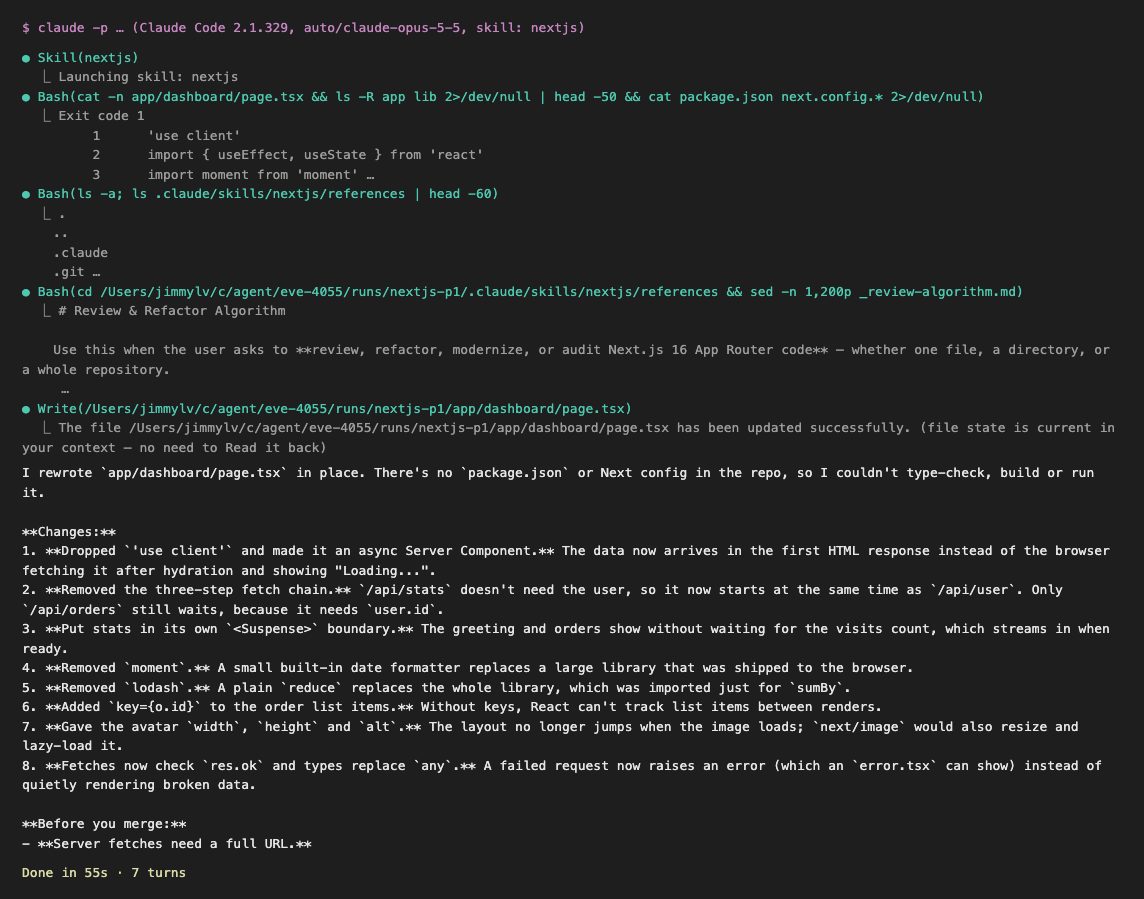
We gave nextjs a 'use client' dashboard with three chained fetches in useEffect, moment and lodash. It turned the page into an async Server Component, started /api/stats in parallel, streamed it in Suspense and removed both libraries. Eight changes, each with a reason.
It also listed four caveats, and those are the check: server fetches need an absolute URL, the user's cookies are not forwarded, the date formatter became UTC where moment was local, and it skipped 'use cache' because the data is per user. If your page relies on the browser's cookies, this rewrite breaks it. The pick says to skip nextjs entirely on a Vite SPA for the same reason.
3. Does the skill assume someone else's repo?
The last step, frontend-code-review, is written against the Dify frontend. Its sibling frontend-testing showed what that means in practice: it told Claude to read web/docs/test.md, a file that only exists in Dify. Claude fell back to Vitest defaults. Use those skills for the review habits and ignore the paths. If you work in Dify itself, they fit exactly.
One more: are you in React Three Fiber?
If the slow component is a 3D scene, the general rules miss the main cause. r3f-best-practices took 28 seconds to replace 2,000 separate meshes with one instancedMesh, move per-frame time from setState into a ref, and name a stale-closure bug in setT(t + d). None of the general React skills would have looked at useFrame.
The order, again
- typescript: make tsc pass and fast.
- react-dev: type the components and hooks.
- vercel-react-best-practices: the review checklist.
- nextjs: only on App Router, and read the cookie caveat.
- cache-components: only after the render is correct.
- frontend-code-review: as the gate, ignoring Dify paths.
- typescript
Loaded on its own, 41s. Slow tsc on a project with a sloppy include or lib setup.
- react-dev
Loaded on its own, 59s. Generic, type-safe React components.
- nextjs
Loaded on its own, 56s. Reviewing a client-heavy App Router page that should be a server component.
- r3f-best-practices
Loaded on its own, 28s. React Three Fiber scenes that re-render or allocate every frame.
- frontend-testing
Loaded on its own, 54s. Dify's frontend, where the docs it references exist.